
|
|
Click here to see Google Global Map of FNI Projects
You can zoom in on project locations using the Plus (+) and Minus (-) icons on the global map. You can also move to different parts of the map by clicking on the Right, Left, Up and Down arrow icons. Look for these icons at the TOP LEFT CORNER OF THE MAP.
|
|
|
|
 |
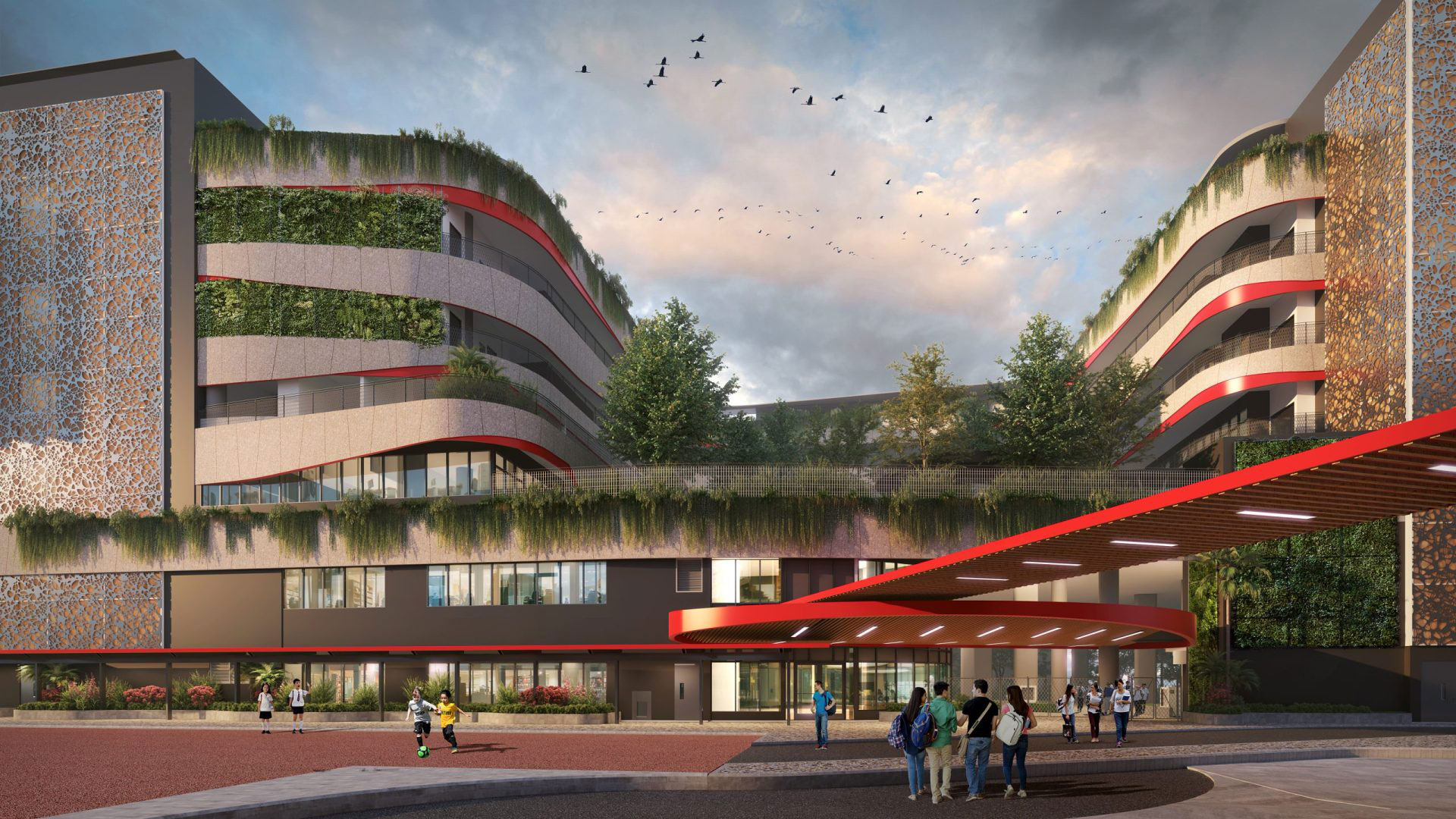
Sinarmas World Academy – Indonesia
The idea of the school grew from a vision of Indah Wijaya who understands that education has long been recognized as the key to improving life – both for individuals, families and society. We all seek to provide the best education that we can. In today’s rapidly changing world, it is becoming increasingly difficult to know exactly what sort of education is needed to prepare our children for a world where many of the industries or jobs they will work in do not yet exist. This requires specific skills and attitudes that are not part of many contemporary school curriculums. John Dewey captured this thought in his quote “If we teach our children as we did yesterday, we rob them of the future.”
|
Take A Visual Tour
|
|
|
|
 |
Scotch Oakburn College, Middle School (2009) – Launceston, Tasmania
The largest of Scotch Oakburn College’s three major building projects since 2005 is a new Middle School for years 6, 7 and 8.
Middle-years education has been a focus for Scotch Oakburn College for several years and this building is a physical
representation of the school’s philosophy on education for students in this age group (11-14).
|
Take A Visual Tour
|
|
|
|
 |
Duke School – Durham, North Carolina
The Duke School project represents a rare opportunity to create an educational environment that truly reflects a 21st century personalized learning program. The project has the potential to marry an innovative academic Pre-K-8 program with an inventive educational environment, what we describe as a ‘10/10’ – a ‘10’ in terms of educational philosophy, and a ‘10’ in terms of school design. The strong school culture and continuous involvement of students, teachers and parents is unlike almost any project we’ve been involved with. Schools at their very best are learning communities, and it is our personal vision to offer a planning and design process that nurtures the highest values of that community. It has been, and continues to be, a joy and a privilege to assist Duke School in fulfilling their noble dream of providing the highest quality, and challenging learning environment for their children.
|
Take A Visual Tour
|
|
|
|
 |
Medford Elementary Schools – Medford, Oregon
Four aging elementary schools in Medford, Oregon were re-built to adapt to the demands of a studentcentered creative age. Roosevelt and Jackson Elementary Schools are featured here. The schools each accommodate approximately 428 students in 57,000 SF. FNI served as the planner and design consultant in 2007. Construction was completed in January, 2010.
|
Take A Visual Tour
|
|
|
|
 |
Herchmer Wascana Community School – Regina, Saskatchewan, Canada
Herchmer Wascana Community Elementary School is one of six new schools in Regina, Saskatchewan, Canada being designed by Fielding Nair International (FNI), all crafted to nurture Creative Age learners and support Regina Public School’s Structural Innovation initiative as well as being environmentally sound and LEED Canada Certified.
The design will accommodate up to 357 students ranging from Pre-Kindergarten through grade 8. The facility includes an Integrated Educational Learning Centre which has been designed to help mainstream special needs students more fluidly with the rest of the student population. A future Daycare Centre can be added next to the Gym.
|
Take A Visual Tour
|
|
|
|
 |
Douglas Park School – Regina, Saskatchewan, Canada
Douglas Park School is one of six new schools designed by Fielding Nair International (FNI) in Regina, Saskatchewan, all crafted to nurture Creative Age learners and support Regina Public School’s Structural Innovation initiative as well as being environmentally sound and LEED Certified.
|
Take A Visual Tour
|
|
|
|
 |
Arcola Community School – Regina, Saskatchewan, Canada
Arcola Community Elementary School is one of six new schools in Regina, Saskatchewan, Canada being designed by Fielding Nair International (FNI), all crafted to nurture Creative Age learners and support Regina Public School’s Structural Innovation initiative.
|
Take A Visual Tour
|
|
|
|
 |
North Central Shared Facility – Regina, Saskatchewan, Canada
The proposed new facility in Regina’s North Central Neighbourhood builds on the vision developed by the community, and will be a “first” for Regina in two important ways:
• the first time such a wide range of community services have come together to build and manage a facility devoted to one urban community; and
• the first time that learning experiences will take place within shared community spaces.
The facility’s tenants will be much more than neighbours – they’ll be working partners in program delivery.
|
Take A Visual Tour
|
|
|
|
 |
The Regina Trades and Skills Centre – Saskatchewan, Canada
The Regina Trades and Skills Centre (RTSC) was initiated in February 2007 as part of a larger goal of revitalizing Regina’s inner city neighborhood and, through a new approach, to better engage the youth in learning and the labor market. Through project based learning, students encounter “real world” experiences and learn practical trades, technical services and skills that they can use to begin work in their selected field. The facility has been designed with maximum flexibility to support the diversified types of instruction at the school. Its conceptual construction details have also been carefully considered to result in a minimum LEED Silver Standard.
|
Take A Visual Tour
|
|
|
|
 |
Cayman Islands Projects
Planning & Design Consultation for 3 New High Schools + Long Range Master Planning for all Schools in the Country
- FNI is serving as the Planner and Design Consultant for 3 new high schools valued at US$140 million.
- FNI is also developing a long range Facilities Master Plan for the Cayman Islands
- Additional Services include: Study and recommendations on Tertiary Education Facilities, Vocational Education System
- FNI is doing an independent educational assessment of all the school facilities on all three islands
- FNI is also providing curriculum consulting, teacher training and educational commissioning across the school system
|
Take A Visual Tour
|
|
|
|
 |
LAS Almaty Project
The ultimate result of the Leysin American School (LAS) Almaty project will be to have created the best school in Kazakhstan with every aspect of the facility exemplifying quality education.
The school will invigorate the community and make a dramatic statement, captivating the attention of all who drive by with both surprise and a monumental presence.
The project, designed by FNI (assisted by MHTN Architects), will propel Kazakhstan into the 21st century, by creating a learning community entirely integrated within the larger community of Almaty, and furnishing it with the latest technologies, while promoting key principles of sustainable development and employing a faculty committed to a 21st century approach to education.
|
Take A Visual Tour
|
|
|
|
 |
George Town Primary School
The Georgetown design in the Cayman Islands is significant because it is the ultimate confluence of the most forward-thinking
ideas in both education and educational architecture for a primary school.
|
Take A Visual Tour
|
|
|
|
 |
Middletown Public Schools
Forest Avenue Elementary School
Pilot Project
|
Take A Visual Tour
|
|
|
|
 |
Cristo Rey Jesuit High School and Urban Ventures Community Athletic Center – Minneapolis, Minnesota
The Cristo Rey education model is like no other and has been remarkably successful in its mission. Every
graduating senior at the school’s pioneering Chicago campus was admitted to college — a remarkable achievement when
you consider that many of the school’s students are the first in their families to graduate from high school. Click here for the
60 Minutes Story about this special school.
(http://www.cristorey.net/)
The Cristo Rey model is built on the concept of providing a top-notch education that is largely funded by
income that the students earn in real white collar corporate jobs in the City. Not only does this model provide a level of
hands-on learning that is unprecedented in most school systems, but it also provides a solid source of financing that the school
can then use to subsidize the students’ education.
The innovation continues in Minneapolis with the new Twin Cities Cristo Rey Jesuit High School
forming a partnership with the Colin Powell Youth Leadership Center. This complex provides students with access to an
extended network of corporate/school internships, arts and civic partnerships on one urban campus.
|
Take A Visual Tour
|
|
|
|
 |
Porirua College – New Zealand
Porirua College is a small high school with big ambition. Over the next three years, it is set to become a flagship facility for 21st Century Learning in New Zealand. FNI is serving as Educational Facilities Planner along with architects Opus and managers Octa Associates.
Porirua is a region known for its diversity: the community comprises largely Pasifika (Pacific Islanders) and Maori families. It is also a region with high rates of unemployment, low income, and low rates of university (college) attendance.
|
Take A Visual Tour
|
|
|
|
 |
“Building Futures” Projects – Victoria, Australia
In Australia, the Victorian Government’s Building Futures funding initiative has spawned a number of projects with Fielding Nair International involvement as
Planning and Design Consultant. There has been growing recognition in Victoria that school stock built in the 1950s and 60s has exceeded its useful life and that
reinvestment in school buildings must contribute to a marked improvement in student learning. Altogether, FNi is participating on 8 separate primary and secondary
schools projects in three communities: Broadmeadows, Bendigo and Geelong. In this capacity, FNI is providing visioning and educational planning, developing concept
designs and design effectiveness evaluations, and teacher professional development services. FNI has also begun work with several other Victorian communities on the
Building Futures program.
|
Take A Visual Tour
|
|
|
|
 |
Scotch Oakburn College – Launceston, Tasmania
Scotch Oakburn College (SOC) was created in 1979 with the amalgamation of Oakburn College and Scotch College. The amalgamation
successfully brought together two fine traditions that stretch back to 1886 and 1901 respectively. The College has a long and
significant connection with the history of the town of Launceston, Tasmania. This project involves a major capital investment
by the College in its Penquite Campus and includes three distinct components: A New Health and Physical Education Center (HPC),
A New Middle School and the refurbishment of the existing gymnasium building at the Robert Dean Center into a new Senior
Student Center.
This project is significant in many ways. It is the first school in Australia to feature FNI’s signature “studios”
– these include the DaVinci Studio, the Einstein Studio and the Julia Child Studio among others. The new HPC and Middle School
are located on a dramatically steep site across the road from the main campus and offers magnificent vistas to the valley and
hills beyond. The design also calls for a complex terracing arrangement. When it is completed, the new campus will firmly
establish SOC as one of the world’s foremost leaders in education and innovation.
|
Take A Visual Tour
|
|
|
|
 |
Horizons Phuket – Phuket, Thailand
Horizons Phuket, in Phuket, Thailand is not just a better community, it is the way of the future. Instead
of developing the “best of the old”, The Horizons Educational Consulting Company has chosen to develop the “first of the new”.
Instead of the familiar notion of developing “the school as community”, Horizons Phuket stands out as the first notable
development worldwide which builds on the idea of “community as school”. Here, lifelong learning is more than a catchphrase, it
is a philosophy that finds expression in every facet of the development. At Horizons Phuket, learning is everywhere and
learning is for everyone. Every home in the community features a specially designed “Satellite Learning Center” that connects
each and every resident, young and old alike, to a rich variety of learning resources within and outside the community. Each
home is a natural extension of the learning community which contains four distinct components – A Pre-Primary Learning Center,
Primary Years Learning Center, A Middle Years Learning Center and a Senior Learning Center. These are connected to other
community-wide resources which include the Town Center, the Health, Fitness and Music/Performance Center, Enviro-Lake, Nature
Walk and the Green Amphitheater – all shared elements with strong underlying learning themes that everyone gets to use. There
is every expectation that this development will put Phuket on the global map once again – but this time for positive,
life-affirming reasons.
|
Take A Visual Tour
|
|
|
|
 |
Bower’s Academy – Bloomfield Hills School District, Bloomfield Hills, MI
Bowers Academy is an alternative high school, founded for “at risk” students, located on the 90-acre Bower’s School Farm. Originally designed as a separate entity from the farm, the school decided to integrate itself into the farm to create a unique partnership after just one design workshop with FNI. This unique educational environment not only places students close to nature, but also offers a creative space for personal development. Students thrive in this small farm-school, balancing academic challenge with spaces for self-reflection and small class sizes.
|
Take A Visual Tour
|
|
|
|
 |
Paideia Academy – Apple Valley, Minnesota
Completion : August 2005
The day after the charter for Paideia Academy was granted in February, 2005, they sent out 10,000 postcards
telling the story of their vision to parents and prospective students. They found a building that until recently had housed
five movie theaters, embarked on a thoughtful planning process and negotiated a deal with the landlord. Just a few months
later, in August 2005, the school launched with immediate success. Each day begins with an all-school meeting in the central
atrium, which features a grand piano (the school has a partnership with a prestigious music institution). Already, the school
boasts a healthy waiting list.
Paideia Academy was designed and renovated 3 times faster and cost less than 1/2 the budget of a typical
school. Tona is spending more time dancing again, Erik is singing in the choir, and their children are flourishing like plants
in a greenhouse. Laura Porter-Jones, Director, said “The school is absolutely beautiful – in 15 years I have never been
privileged to work in a facility half as lovely as this one. Thank you!”
|
Take A Visual Tour
|
|
|
|
 |
Millennium
High School – New York City (with HLW International). An
innovative school near ground zero in New York City completed in 2003. Delivered
in record time and for a small fraction of what most new schools cost. Plan
is developed without corridors, with abundant daylighting and permits multiple
modalities of learning to occur simultaneously within and outside classrooms.
|
|
|
|
|
 |
Morriss Center High School – Bridgehampton, NY
Completion: 2007
Set on beautiful farmland adjacent to an existing elementary and middle
school, the new high school will be a model for new paradigm education.
The school facility design will be research-based, community driven, environmentally
sensitive and fiscally responsible. |
|
|
|
 |
East
Side High School – Newark, NJ
Completion: 2007
This $65 million project is really four thematic academies – science
& health, humanities, business & technology and communications
& law. The school will feature various innovative approaches to school
design and be constructed with close attention paid to high performance
principles. |
|
|
|
|
 |
Heriman Middle School – South Jordan, UT
(with MHTN Architects).
Completion: 2006
Project awarded via design competition. Flexible plan with small learning communities,
developed within a tight budget. High performance design is highly efficient
with little wasted space. Project is now in design. |
|
|
|
 |
Yeshiva Elementary School – Milwaukee, WI
Impact on Learning and Honor Awards 2002. A private K-8 school in Milwaukee,
Wisconsin. Described in a review by critic Whitney Gould as "a child’s dream."
|
|
|
|
 |
Kindergarten
Development Center – Qatar
Completion: 2006
This project will be a model, world-class kindergarten facility and also
serve as a training center for teachers. It will feature L-shaped classrooms
with various activity-centers and a seamless connection between indoors
and outdoors. |
|
|
|
|
 |
Advanced
Learning Environment Modules
Completion: 2005
These modules are far superior to traditional temporary space because
they are developed from the ground up to be the best possible environments
for learning. The modules can also be combined to create complete schools
that can be operational from planning to occupancy in about six months.
They have tremendous flexibility and can be configured for use by any
school population. A variety of purchase and leasing options are available.
|
|
|
|
 |
Harbor City International School – Duluth, MN
Completion: 2001
Honor Award 2002. A public charter high school in Duluth, Minnesota. Referred to in an article published in Education Week as "A new paradigm school."
|
|
|
|
|
 |
Goa
International School – Goa, India
Completion: 2006
To be set on 50 acres along Goa’s beautiful beachfront,
GIS will be one of India’s premier educational institutions. FNI
is serving as the school’s planning and design consultants. We are
collaborating on this project with Indian Architects Dennis Coelho and
Associates and the Auroville Building Center – Suhasini Ayer – Architect. |
|
|
|
|
 |
The
Andre Agassi College Preparatory Academy – Las Vegas, NV
Completion: 2007
The Andre Agassi School is recognized nationally for the great
success it has had in developing a sustainable model of quality urban
education in Las Vegas, Agassi’s home town. Agassi Prep is now building
a new high school to meet and exceed the high standards already established
by the existing middle school. FNI was recruited by the Agassi Foundation to
help "vision" and plan the new high school facilities and to coordinate the work
of various other educational consultants engaged by the Foundation and with the
school’s architects Carpenter Sellers Architects.
|
|
|
|
 |
High School for Recording Arts (Hip Hop High) – St. Paul, MN
Completion: 2002
A public charter school in St. Paul, Minnesota. A high school about hope,
hip-hop and lifelong learning.
|
|
|
|
|
 |
TakingItGlobal
Completion: Various Years
Merit Award 2002. Prototype designs for technology-rich, global
youth learning centers. Taking cyber cafes to the next level – building
learning communities for teenagers.
|
|
|
|
|
 |
Avalon School – St. Paul, MN
Designed for Project-Based Learning. A public charter high school in St.
Paul, Minnesota, designed for collaborative learning. |
|
|
|
|
 |
Reece High School – Devenport, Tasmania, Australia
Merit Award 2002
Winner, McConnell Award 2003
Completion: January 2003
Special Features: Floor plans for this 600-student school demonstrate
real flexibility and program integration instead of 20th century “bells and cells”.
This new school is explicitly designed to accommodate project-based learning and is a
real attempt to integrate education with architecture. Imagine having the ability to recreate
the classroom environment whenever appropriate to fit any desired instructional strategy –
that is indeed the way this school is designed. The innovative ideas embodied in this school
design have been incorporated into statewide policies. |
|
|
|
 |
Great
River School – St. Paul, MN
Completion: 2004
The first Montessori High School in Minnesota is also a “St. Paul Star School,”
supported by the Hubert Humphrey Institute Center for School Change, along
with the Gates Foundation, Hamline University, and the University of Minnesota.
Both a new middle and high school are located in a renovated two-story office building.
The heart of each school is a cafй/commons area. Unique spaces such as an “R & D Garage”
take this school out of the realm of “school” and make this an environment that integrates
work-like activities, scientific enquiry and life-long learning.
|
|
|
|
 |
River Heights Charter School – St. Paul, MN
Completion 2004
One of a series of high schools designed by FNI using the EdVisions Learning
Cooperative’s project-based learning curriculum. The new school is located within
an existing office building in West St. Paul, Minnesota. Rather than organizing
around classrooms, River Heights is designed around advisory groups of 15 to 18
students each, and includes individual workstations for each student and advisor/teacher.
|
|
|
|
|
 |
Community Trade and Business Center – Milwaukee, WI
Completion 2004
CTBC is a new charter high school that is renting space from Malcolm X High School in Milwaukee.
CTBC is located in an economically depressed neighborhood and has one of the lowest
graduation rates in the U.S. The school was founded by two former basketball players
and best friends that became successful in business and wanted to give back to the “hood.”
|
|
|
|
 |
Pathways World School – New Delhi, India
Citation Award, 2003
Completion: September 2003
Special Features: The 1,150 students at this school can have one-on-one
lessons from peers or teachers in so-called “formal learning zones”.
Here, they serve as teachers themselves, write, read, present, draw and
build in the formal learning or classroom zones. The immediate area outside
the classroom serves as an extension of the learning experience and is designed
to encourage informal student gatherings. There are quiet zones and green zones.
Large group gathering spaces include the central tiered amphitheater around a large
water body intended for both informal and formal gatherings. The school is designed
around the principles of Multiple Intelligences theory.
|
|
|
|
|
 |
Canning Vale High School – Perth, Western Australia
Architect: HASSELL/VITETTA. Planner, Prakash Nair
Photos: Keith Lightbody and Randall Fielding
Completion : January 2004
Honor Award 2002
Special Features: This 1,200 student high school was developed from a set
of 10 guiding principles that included the nurturing of mind, body and
spirit and the personalization of learning experiences. The resulting
design is a playful mix of forms representing various learning neighborhoods,
which lie along a learning street that leads to the colorful campus center.
|
|
|
|